
Financial planning insight
Income Protection vs Critical Illness Cover: Difference?
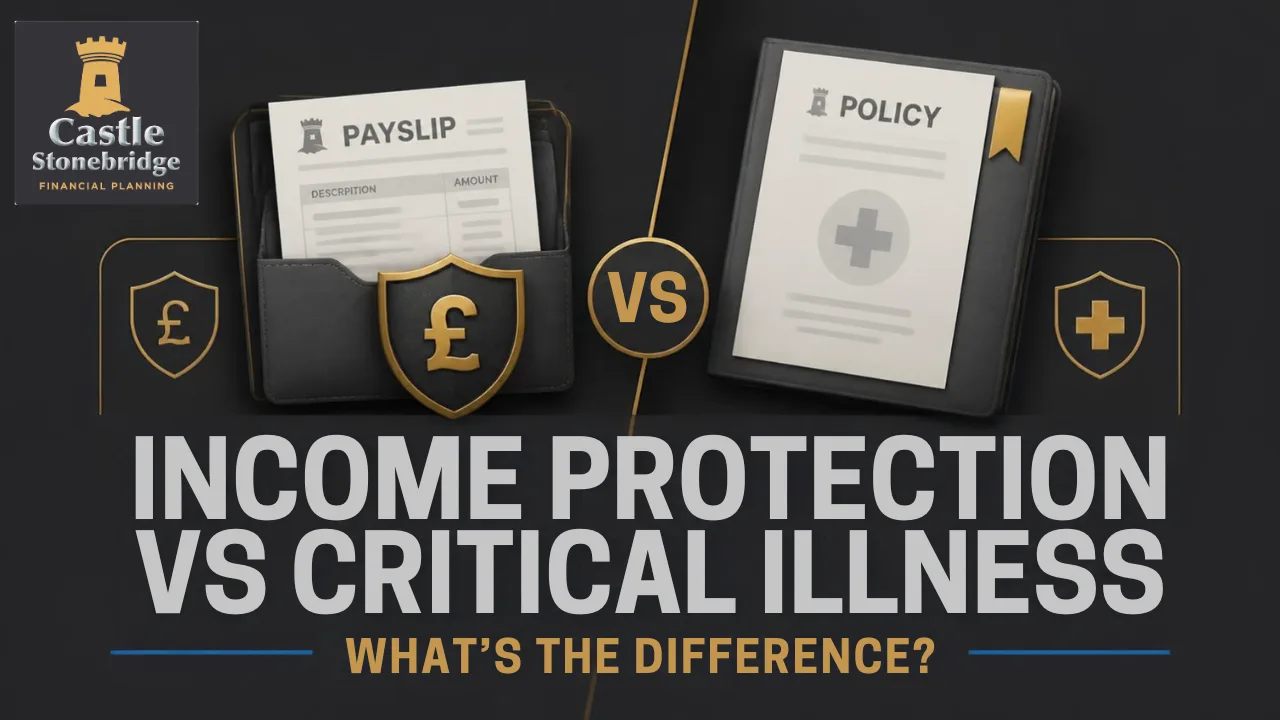
If you are comparing income protection vs critical illness cover, the most important thing to understand is that they protect you against different financial problems. One is designed to replace part of your income if you cannot work because of illness or injury. The other generally pays a one-off lump sum if you are diagnosed with a specified critical illness.
That means the choice between income protection vs critical illness is not necessarily about picking one policy over the other. Depending on your circumstances, having both can provide different types of financial protection.
Income protection vs critical illness: what is the difference?
The simplest way to compare income protection vs critical illness is to look at what causes the policy to pay out and what happens afterwards.
Income Protection | Critical Illness Cover | |
|---|---|---|
What triggers a claim? | You are unable to work because of illness or injury | You are diagnosed with a specified critical illness covered by the policy |
How does it pay? | Regular monthly income | Usually a one-off lump sum |
How long can it pay? | Potentially until you return to work or the end of the policy | Usually one payment, after which the cover ends |
What can the money be used for? | Everyday living costs, mortgage, bills and other expenses | Mortgage, treatment, home adaptations, debts or other costs |
Does the illness have to be specified? | Generally no, provided it meets the policy's incapacity definition | Yes, the condition must meet the policy definition |
Main purpose | Protecting your earnings | Providing a lump sum following a serious diagnosis |
MoneyHelper explains that income protection can typically replace part of your income if you cannot work due to illness or an accident, while critical illness cover provides a one-off payment following diagnosis of a specified condition.
Which is better: income protection or critical illness cover?
There isn't one answer that applies to everyone.
When considering income protection vs critical illness, think about the financial problem each policy is solving.
If you could not work for six months because of a back injury, for example, you might not have a critical illness claim because the condition is not one of the specified illnesses covered by the policy. Income protection could potentially provide a monthly income if the claim meets the policy's definition of incapacity.
On the other hand, if you were diagnosed with a qualifying form of cancer, a heart attack or a stroke, critical illness cover could provide a lump sum that could be used however you need.
The definitions and exclusions vary between insurers, so the specific policy wording matters. MoneyHelper's guidance on critical illness cover and what policies can include is a useful starting point.
Can I have both income protection and critical illness cover?
Yes. In fact, this is an important consideration when looking at income protection vs critical illness.
The two policies can work alongside each other because they can respond to different circumstances.
Imagine you are unable to work following a serious illness that qualifies under your critical illness policy. You could potentially receive the critical illness lump sum while also having income protection available if you remain unable to work and meet its claim conditions.
The lump sum could help with a mortgage, adapting your home or paying for additional costs, while income protection could help maintain your regular household income.
This is particularly relevant if your family depends heavily on your earnings or you are self-employed without substantial employee benefits.
Key point: Income protection is primarily about replacing lost earnings. Critical illness cover is primarily about providing a lump sum following a qualifying diagnosis.
Which is cheaper: income protection or critical illness cover?
There is no fixed answer because premiums depend on factors including age, occupation, health, smoking status, the amount of cover and the policy terms.
Income protection can be more expensive than some forms of critical illness cover because it is designed to potentially provide an ongoing monthly benefit rather than a single payment.
However, price should not be the only consideration when comparing income protection vs critical illness.
A cheaper policy that does not provide the protection you actually need may leave a significant gap.
For income protection, factors such as the deferred period, occupation definition, level of cover and length of benefit should all be considered. MoneyHelper notes that common deferred periods include four, 13, 26 weeks and one year, with longer waiting periods generally reducing premiums.
Do I need income protection if I already have critical illness cover?
Possibly.
Critical illness cover does not generally replace your income simply because you cannot work. You normally need to meet the policy's specific critical illness definition.
This means someone could be unable to work for a prolonged period without receiving a critical illness payout.
Income protection is designed around your ability to work rather than whether you have been diagnosed with one of a defined list of conditions.
For someone whose biggest financial asset is their future earnings, this distinction can be important.
Do I need critical illness cover if I have income protection?
Again, it depends on your circumstances.
Income protection could help replace part of your earnings while you cannot work, but it may not provide the large immediate lump sum that could be available through critical illness cover.
For example, following a serious diagnosis, you might want to repay part of your mortgage, make changes to your home or reduce your working commitments. A lump sum can provide flexibility for those costs.
This is why comparing income protection vs critical illness in isolation can sometimes miss the bigger picture.
How much income protection and critical illness cover do I need?
Your cover should reflect your financial commitments rather than simply choosing an arbitrary figure.
For income protection, consider:
Your monthly income
Mortgage or rent
Essential household bills
Existing savings
Sick pay or employee benefits
How long you could manage without your normal income
For critical illness cover, consider:
Mortgage and other debts
Dependants
Household expenses
Potential treatment or recovery costs
Whether you may want to reduce your working hours
Your existing savings and protection
The Association of British Insurers' guidance on insurance and protection provides further information on choosing appropriate insurance cover.
Income protection advice in Chesterfield and Sheffield
For people in Chesterfield, Sheffield and surrounding Derbyshire areas, protection needs can vary considerably depending on employment, income and family circumstances.
An employee with a strong employer benefits package may have different requirements from a self-employed builder, business owner or professional who would have little income if they could not work.
At Castle Stonebridge, we can review your existing protection alongside your wider financial position. You can find out more about our approach through Independent Financial Advisers | Castle Stonebridge Financial Planning.
So, which should I choose?
The income protection vs critical illness decision comes down to the type of financial risk you are trying to protect against.
If your priority is maintaining an income when illness or injury prevents you from working, income protection may be relevant.
If you want a lump sum following a qualifying serious illness, critical illness cover may be relevant.
For some people, the two can complement each other rather than compete.
The important part is making sure the policy definitions, level of cover and terms match your circumstances. A review can also identify whether you already have cover through your employer or existing policies, so you are not paying for protection you do not need.
*Disclaimer: This article is for general information only and does not constitute personal financial advice. The suitability and cost of Protection will depend on your individual circumstances and the terms of the policy.